
One of the most expensive mistakes made in choosing a metal building size isn’t structural failure, it’s undersizing. Buildings are routinely designed to meet immediate operational needs while ignoring growth, code interpretation, and how reviewers actually evaluate future use.
From what we see during plan review and post-occupancy changes, buildings that appear “right-sized” on paper are often the first to require reconfiguration, expansion, or costly retrofits within a few years. At that point, correcting the issue is far more expensive than addressing it during initial design.
This blog serves as a practical guide on how to choose metal building size correctly, built from repeated exposure to real-world projects across multiple jurisdictions.
Projects that are sized only to meet immediate operational needs often require costly corrections later. Understanding how to choose metal building size with long-term needs in mind is key to avoiding these expensive adjustments. The objective is simple: help you size and scope a metal building that survives plan check, functions operationally, and remains adaptable long term.
Start With Use Cases (Now + Anticipated)
Before we dive into the details, it’s important to understand that choosing a metal building size starts with defining its use, both today and in the future. A thorough understanding of how the space will function ensures that the final design aligns with both current needs and future growth, helping to avoid costly revisions and underutilized spaces later on.
Define Current Functional Requirements
Begin by clearly defining the building’s current functional requirements, focusing on measurable and operational needs. Start with measurable, operational needs:
- Storage: Equipment, materials, inventory, or vehicles
- Operations: Manufacturing flow, service bays, showroom space, offices
- Equipment Footprints: Physical dimensions plus required clearance for operation, maintenance, and safety
A common assumption we see during early planning is that total square footage equals usable space. In reality, circulation paths, safety clearances, and access requirements routinely reduce usable area. These gaps are rarely caught during review, but they surface quickly once the building is in use.
Design for function, not just area.
Plan for 5–10 Years of Growth
Most buildings outgrow their original layout faster than expected. Equipment changes, staffing increases, and workflow adjustments are normal, not exceptional.
Across multiple projects, one of the most consistent post-approval issues is owners returning for layout changes or expansion because future growth was acknowledged conceptually but never translated into dimensions. Thus, one of the key principles in learning how to choose metal building size is factoring in future growth from the very beginning.
To avoid that:
- Project realistic increases in floor area
- Anticipate new equipment or process changes
- Allocate additional circulation, staging, and service space
Sizing benchmark based on field patterns: Add a 15–25% square footage buffer to your calculated needs. Projects that skip this buffer are significantly more likely to require expansion or rework within the first few years.
Footprint vs. Height: Where Most Buildings Get Locked In
Usable space isn’t defined by square footage alone. Proportions, especially ceiling height play a critical role in how functional and comfortable a space truly is. This is often where many designs fall short, overlooking the spatial dynamics that directly impact usability and long-term satisfaction.
Width & Length Considerations
The footprint must support:
- Equipment and racking layouts
- Vehicle turning radii and service access
- Efficient column spacing
From a constructability and usability standpoint, poorly planned column spacing is a frequent source of redesign. The building may technically meet size requirements, but the interior becomes inefficient once real equipment is installed.
Eave Height Planning (Frequently Underestimated)
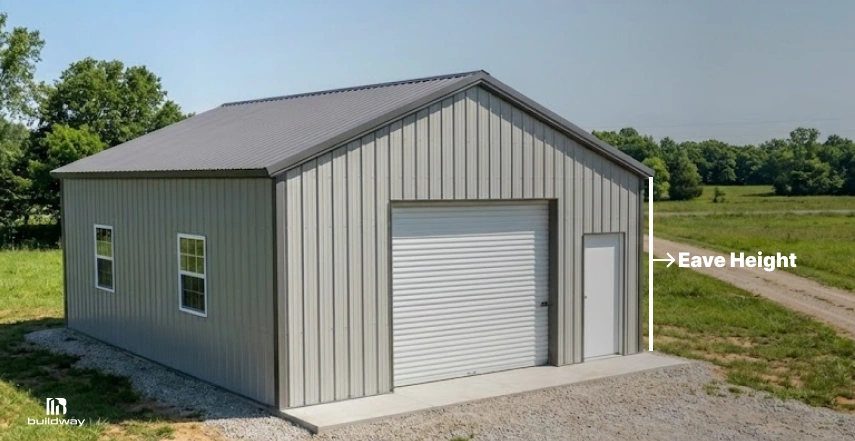
Eave height is one of the most under-designed variables we see during plan review and post-occupancy changes. Height must account for:
- Racking and vertical storage
- Lifts, cranes, or overhead equipment
- Future mezzanines
- Structural depth, lighting, and fire protection
- Air circulation and daylighting
A common assumption that leads to resubmittals is designing height only for current equipment. Reviewers don’t assume future upgrades are “non-structural.” If a use is reasonably foreseeable, they expect the structure to accommodate it.
Reality: Increasing height later requires roof modification, structural reinforcement, and new permits. It is consistently more expensive than extending floor area.
Roof Style Implications
Roof geometry has a direct impact on interior clearance, structural loads, and the complexity of permitting and code review. Its form influences both the functionality of the space and the ease or difficulty of the approval process.
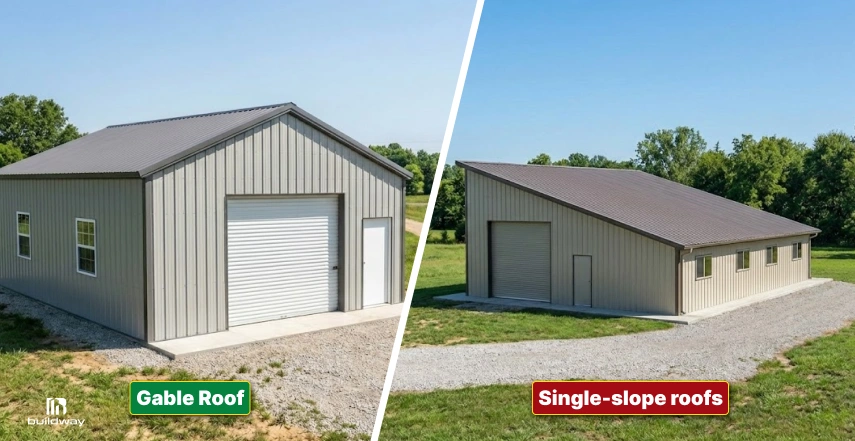
- Gable roofs: Better symmetry, snow load performance, and vertical clearance
- Single-slope roofs: Useful for drainage constraints or adjacent structures
From a review standpoint, roof geometry influences load paths and height calculations: two areas where late changes can trigger full re-review.
Rule learned through repetition: If height is uncertain, size upward early. Height is far harder to correct later than footprint.
Common Interior Layout Oversights
Even when a building is sized correctly on paper, poor internal layout decisions can compromise operational efficiency, safety, and future adaptability. Here are common mistakes to avoid during the planning phase:
Ignoring Workflow Sequencing
Position equipment, staging areas, and workstations in a way that supports the natural flow of operations. Poor sequencing often leads to unnecessary movement, congestion, and reduced productivity.
Under sizing Access Points
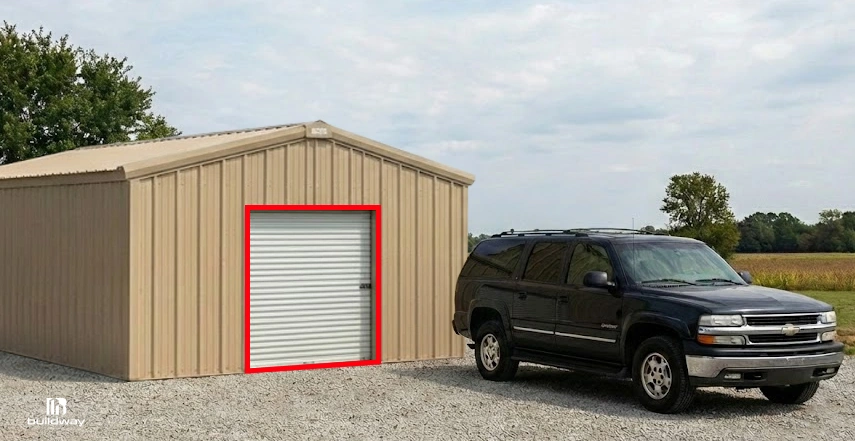
Ensure that all access points including doors, internal bays, and loading docks are adequately sized for your largest equipment, vehicles, or materials. Tight clearances can cause delays, damage, or require expensive modifications later.
Neglecting Internal Zoning
Delineate different areas within the building for specific uses such as:
- Clean operations
- Storage
- Office/administration
- Noise-isolated zones
Establishing operational zones early helps streamline layout and reduces cross-contamination or inefficiency.
Rigid or Fixed Partitioning: Avoid permanent interior walls unless absolutely necessary. Use modular, reconfigurable partitions to allow for future adjustments as workflows, staffing, or space needs change.
A well-sized building can still fail operationally if internal layouts are inflexible or poorly organized. Design inside the box, not just the box itself.
Check Local Rules Early: Zoning & Code Examples
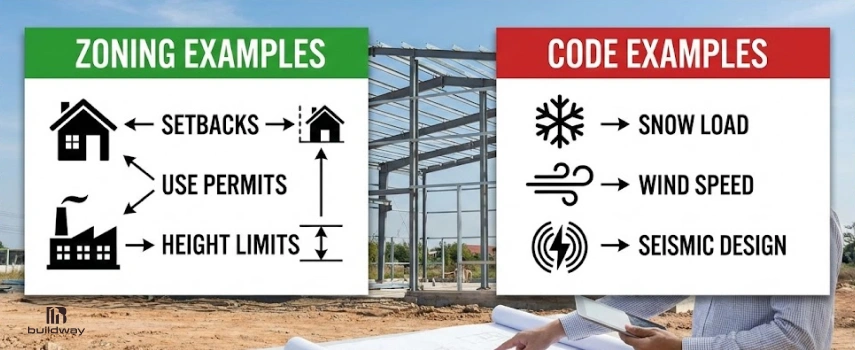
Even a well-designed metal building can fail during plan review if it doesn’t align with local zoning, safety, or environmental codes. Requirements vary dramatically by region, making early code review essential.
Here are examples of location-specific constraints that could impact your design:
- California: Due to seismic activity, structural requirements are more rigorous. Foundations, anchoring systems, and lateral bracing may need to be upgraded to meet seismic zone criteria.
- Texas: In high-wind zones, especially in coastal or tornado-prone areas, roof systems and wall connections often require reinforced tie-downs and wind-resistant design.
- Oregon: Snow loads, slope requirements, and egress calculations change based on altitude and county. For example, certain regions require steeper roof pitches or heavier trusses for snow shedding.
Pro Tip: Always schedule a pre-submittal meeting with your AHJ (Authority Having Jurisdiction) to clarify:
- Zoning restrictions (height, setbacks, lot coverage)
- Occupancy and fire safety classifications
- Egress routes, parking, and accessibility
- Required environmental reports or inspections
Don’t assume national code compliance is enough. Your building must satisfy all local interpretations and overlays.
Understand Site & Code Constraints Before Locking Dimensions
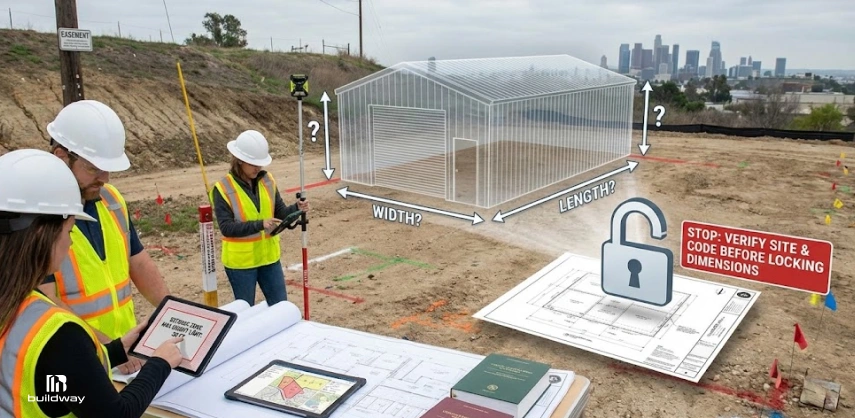
Many sizing issues aren’t the result of design flaws, but rather conflicts with site conditions or building codes that are uncovered too late in the process. Identifying these constraints early is essential to avoid costly revisions, delays, and compromised functionality.
Before finalizing building dimensions, confirm:
- Zoning requirements: Setbacks, lot coverage, maximum height
- Environmental loads: Wind, snow, seismic
- Fire and life safety: Occupancy classification, egress, fire separation
- Utilities and access: Power, water, stormwater, roadway access
This is where many projects fail initial review. Buildings are often sized perfectly for operations but exceed zoning limits or fail circulation and egress expectations, triggering redesigns or scope reductions under pressure.
Plan Review Reality
This is where many metal building projects stall or fail initial review. From repeated plan checks, AHJs most often flag:
- Buildings sized to operational needs but exceeding height or lot coverage limits
- Insufficient eave height once structural depth, lighting, and fire protection are added
- Layouts that technically meet square footage requirements but fail circulation or egress criteria
A common assumption that leads to resubmittals is treating future equipment, mezzanines, or expansion as “out of scope.” Reviewers don’t. If it’s foreseeable, they expect it to be structurally supported.
Projects that move smoothly through review are typically those sized with code margins and future load paths already resolved, not just minimum operational needs.
Match Scope to Budget Without Designing Yourself Into a Corner
Budget overruns are rarely the result of building size alone. More often, they stem from an unclear or incomplete project scope. Without clearly defined expectations, even well-sized projects can face significant financial challenges during design and construction.
What “Scope” Actually Means
When it comes to review and pricing, “scope” includes everything that defines the project’s full extent, from systems and finishes to site work and code requirements, all of which have a direct impact on cost, timeline, and approvals.
From a review and pricing standpoint, scope includes:
- Foundation and site preparation
- Insulation, lighting, HVAC
- Interior partitions and finishes
- Mezzanines and equipment supports
One of the most common disconnects we see is assuming systems can be deferred, only to discover they are required for occupancy approval.
Common Scope Tiers
Most projects can be grouped into one of three clear categories, each with its own set of priorities and challenges:
- Shell Only: Structural system only
- Functional Shell: Utilities and insulation installed
- Operational-Ready: Fully built out for immediate use
Consistent cost pattern: Building excess volume now and phasing interior buildout later is almost always cheaper than modifying structure, foundations, or rooflines after the fact.
Design for Expansion From the Start
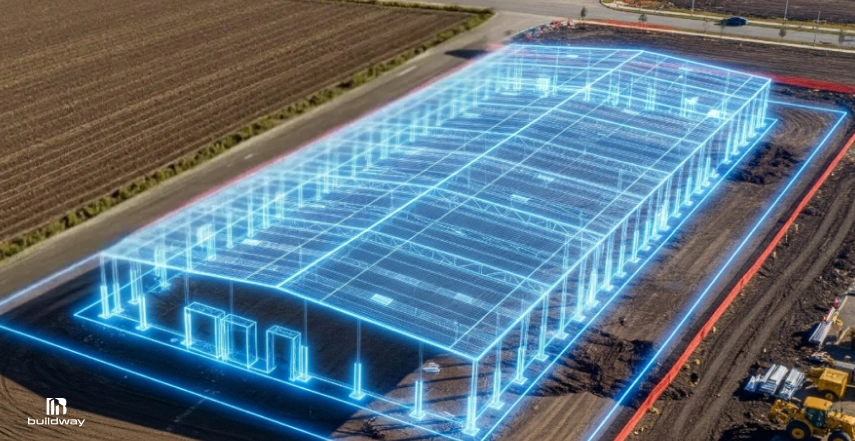
Even buildings that are appropriately sized at the start will eventually face growth pressure as needs evolve. That’s why it’s important to incorporate design strategies that remain effective over time. Strategies that offer flexibility, adaptability, and long-term value.
Design strategies that consistently hold up:
- End walls designed for future removal or extension
- Uniform bay spacing
- Slightly oversized foundations and utilities
- Reconfigurable interior partitions
Buildings designed this way tend to pass future reviews with minimal friction. Buildings that don’t often encounter structural and zoning constraints that make expansion impractical.
Quick Metal Building Sizing Check (Field-Tested Method)
Before locking in early design concepts or submitting for review, it’s essential to know how to choose metal building size based on operational, spatial, and regulatory needs.
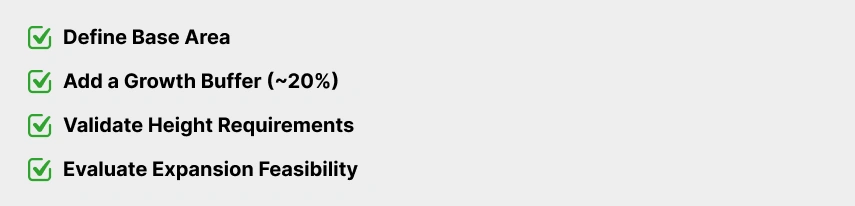
Step 1: Define Base Area
Start by calculating the core functional footprint. Account for:
- Equipment layout
- Operational zones (e.g., workstations, staging areas)
- Required circulation space (aisles, paths, access clearances)
This forms the foundation of your usable area.
Step 2: Add a Growth Buffer (~20%)
Apply an approximate 20% buffer to accommodate near-term growth, operational inefficiencies, or unexpected equipment changes. This built-in flexibility can prevent premature outgrowing of the space.
Step 3: Validate Height Requirements
Don’t overlook vertical space. Ensure the height accommodates:
- Future racking and mezzanines
- Lift equipment clearance
- Structural depth and HVAC/plumbing runs
- Lighting, ventilation, and airflow requirements
Checking this early avoids costly surprises in code compliance and system integration.
Step 4: Evaluate Expansion Feasibility
Assess whether future expansion is physically or financially viable on the site.
- If expansion will be difficult or impossible later, consider oversizing the structure now.
- Plan access points, utilities, and structural layout accordingly.
This quick check catches the most common sizing problems before they become resubmittals or field changes. It’s a practical tool used in real-world planning to ensure the building’s footprint and volume support both current and future operational needs, without overdesigning or underbuilding.
Common Metal Building Sizing Mistakes
These are patterns we see repeatedly across jurisdictions:
- Designing only for current use
- Underestimating height requirements
- Ignoring circulation and staging space
- Value-engineering out flexibility
Every one of these decisions tends to resurface later, at a much higher cost.
Bonus: Pre-Construction Sizing & Scope Checklist
Use this practical checklist to validate your early design decisions before locking in dimensions or submitting for plan review. These field-tested questions catch oversights before they become costly issues.
Sizing & Layout
- Have you mapped current and future equipment dimensions?
- Did you include clearances for operation, maintenance, and circulation?
- Have you applied a 15–25% square footage buffer for growth?
Vertical & Structural Considerations
- Does your eave height account for equipment, racking, mezzanines, lighting, and HVAC?
- Is roof geometry optimized for your snow, wind, or drainage requirements?
- Have you reviewed structural load paths for future modifications?
Utility & Infrastructure Planning
- Are electrical, plumbing, and HVAC systems sized for anticipated upgrades?
- Is your foundation designed to support potential future expansions or mezzanines?
- Are internal partitions flexible or modular?
Compliance & Permitting
- Have you verified zoning limits on height, setbacks, and lot coverage?
- Do you meet egress, fire separation, and occupancy code requirements?
- Have you scheduled a pre-submittal meeting with your local AHJ?
Print this checklist or turn it into a pre-design worksheet. It will save time, money, and frustration during plan review and construction.
Final Takeaway: Size for Evolution, Not Minimums
Learning how to choose metal building size with both present and future needs in mind is what separates functional, long-lasting buildings from costly missteps. Projects that size only to immediate minimums often require correction later, through costly retrofits, operational compromises, or constrained growth.
Across repeated projects, a consistent pattern emerges:
- Flexibility outperforms tight optimization: Designs that allow for change adapt more easily as operations evolve.
- Height functions as insurance: Vertical capacity preserves options for future equipment, racking, and system upgrades.
- Expansion-ready designs retain value longer: Buildings that can grow physically and functionally, remain useful and relevant far beyond their initial use.
Ultimately, size and scope should support how the building is expected to evolve, not just how it will operate on day one.
Ready to plan your building the right way? Avoid costly sizing mistakes. Whether you’re just starting or scaling up, Buildway can help you understand how to choose metal building size effectively. Book a call with our team, get a quote, or explore our clearance buildings for the best deals available.
Frequently Asked Questions
1. What size metal building do I need?
To determine the right size, calculate the space required for equipment, operations, and circulation. Then, add a 15–25% buffer for future growth. Buildings sized only for current use are much more likely to require early and expensive expansion.
2. What is the most common metal building sizing mistake?
The most frequent mistake is underestimating eave height. Height affects storage capacity, equipment clearance, fire protection systems, and the ability to add mezzanines. Unlike floor area, increasing height later is costly and complex.
3. Why do metal building plans fail review?
Common reasons include:
- Zoning height violations
- Insufficient clearance after adding HVAC, sprinklers, or lighting
- Poor circulation or egress paths that don’t meet code
Planning for these early helps avoid delays and redesigns during permitting.
4. Is it cheaper to build larger now or expand later?
In most cases, it’s more cost-effective to build larger upfront and phase the interior buildout over time. Structural expansions often require new foundations, roof modifications, and updated permits, making them significantly more expensive than initial oversizing.
5. Can metal buildings be designed for future expansion?
Yes. Designing with end-wall expansion, consistent bay spacing, and oversized utilities can make future additions faster, cheaper, and less disruptive. Planning for growth during initial design saves time and money down the road.
6. How tall should a metal building be?
Standard eave heights typically range from 12 to 20 feet. However, buildings using racking, lifts, cranes, or mezzanines often need more vertical clearance than initially expected. Always validate height based on current use and future flexibility.